Most institutions competing for enrollment are running the same playbook: paid search, social retargeting, SEO, and email drip sequences. They optimize for clicks, celebrate cost-per-lead benchmarks, and wonder why their enrollment numbers aren’t moving. The problem isn’t the budget. It’s the audience strategy.
Advertising in education has a targeting problem. The students who represent the greatest long-term enrollment opportunity — military learners, Hispanic and Black American adults, Gen Z first-generation students, and high schoolers in the pipeline — require specialist access, authentic cultural strategy, and omni-channel execution that generic digital agencies simply aren’t built to deliver. At Refuel Agency, we’ve spent 35+ years building exactly that. This is what audience-first advertising in education actually looks like.
The Enrollment Opportunity Most Institutions Are Missing
U.S. higher education is in a squeeze. Traditional applicant pools are shrinking, competition for the same general market students is intensifying, and rising digital media costs are making it harder to justify broad-reach campaigns. The institutions winning on enrollment aren’t outspending competitors — they’re out-targeting them.
Three audience segments represent enormous, under-recruited enrollment opportunity in 2026:
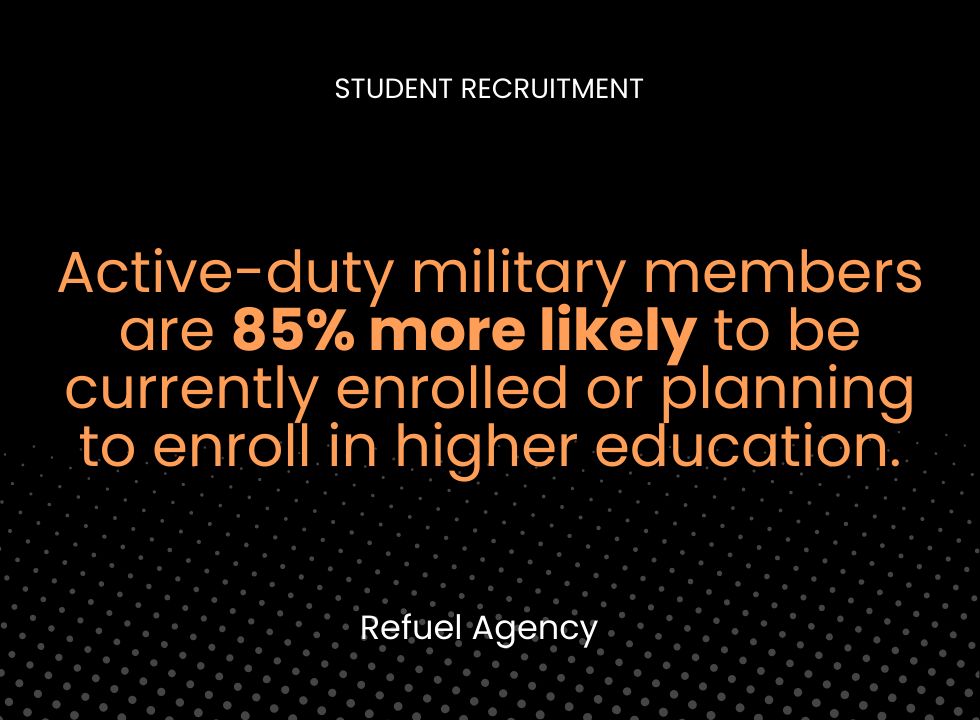
- Military learners: Approximately 820,000 undergraduate students in the U.S. are military-connected, with active-duty members 85% more likely to be currently enrolled or planning to enroll in higher education. Forty-two percent of Active Duty plan to enroll in college within the next six months — a compressed decision window that rewards institutions already in market.
- Multicultural students: Hispanic students now represent 20% of U.S. college enrollment. Non-white students make up 46% of the total undergraduate population — and that share is growing. Yet the vast majority of advertising in education still defaults to general market creative and general market channels.
- Gen Z and the high school pipeline: 61% of current college students are Gen Z. They are 4.1x more likely to engage with TikTok than the general population, spend an average of 11.7 hours per week on the platform, and are simultaneously 35% more likely to notice out-of-home media than the average consumer. They do not respond to one-channel campaigns.
These aren’t marginal audiences. They are the future of higher education enrollment. The institutions and agencies that treat them as specialty add-ons — rather than primary targets — are leaving meaningful enrollment revenue on the table.
Why Standard Higher Education Marketing Falls Short
Standard advertising in education typically prioritizes one of two things: either driving search traffic to an enrollment landing page, or running awareness campaigns through mass digital channels. Both have value. Neither is sufficient when your target student requires authentic cultural connection, physical presence in their community, or navigation of federally regulated environments like military installations.
Here’s where generic strategies fail most:
- They target the intent but not the identity. Military students aren’t just looking for online degrees — they’re evaluating whether your institution understands their lifestyle, respects their service, and will support their transition. GI Bill messaging buried in a footer doesn’t communicate that.
- They translate but don’t connect. Most multicultural campaigns amount to Spanish-language translations of general market creative. That’s not in-culture advertising — it’s in-language guessing. There’s a meaningful difference, and prospective students know it immediately.
- They go digital while the audience goes physical. For military students, 84% of Active Duty members who saw a billboard or out-of-home ad were influenced to buy or enroll. On-campus media drives 56% of college students to research a brand and makes them 70% more likely to take action. Physical presence matters — and most digital agencies can’t deliver it.
- They ignore the pipeline. High school students are making college decisions years before they apply. Advertising in education that doesn’t reach students inside schools — not just on their social feeds — misses the moment when institutional brand affinity is actually being formed.
The result: high spend, low differentiation, and enrollment results that plateau.
Military Student Recruitment: What On-Base Access Actually Delivers
Recruiting military students isn’t difficult if you know where to reach them and how to speak their language. It is nearly impossible if you don’t. Military bases are federally regulated environments. Access to on-base media — fitness centers, dining facilities, base newspapers, transit corridors, digital screens — requires long-term relationships, compliance expertise, and logistical infrastructure that takes years to build.
Refuel’s MilitaryScapes™ network provides exactly that: on-base access across 280+ military installations nationwide, backed by our proprietary Military Explorer™ research — a 1,750-person annual study of Active Duty, Reserve/National Guard, Military Spouses, Post-9/11 Veterans, and Retirees that no competitor publishes at this scale.
The data shapes every strategy we build:
- 42% of Active Duty are planning college enrollment in the next six months — timing matters as much as targeting
- Advertising directly influences 26% of Active Duty college enrollment decisions — higher than admissions counselors (11%) and printed brochures (12%)
- Top selection factors for Active Duty choosing a college: cost, education quality, online learning options, area of study, and whether the institution specifically serves military learners
- Active Duty members are 30% more likely to read a base print newspaper and 38% more likely to engage with on-base OOH than the general population
Our work with American Public University System (APUS) demonstrates exactly what this access produces in practice. Beginning in 2017 with American Military University (AMU), Refuel built a multi-year, on-base out-of-home campaign that evolved alongside APUS’s growth — eventually expanding to include American Public University (APU) targeting military spouses, and Rasmussen University nursing programs. A Q2 brand lift study confirmed a 63% net lift in website visitation from on-base OOH placements — 2.6x the industry benchmark — with a 64% lift in priority markets including Jacksonville, Raleigh, San Diego, and Waco.
This is what advertising in education looks like when physical presence, research, and cultural fluency operate together. You don’t just drive awareness. You drive enrollment intent at the exact moment service members are evaluating their next step.
Want to reach military students at scale? Explore Refuel’s military marketing capabilities or read our ultimate guide to military advertising to see the full picture.
Multicultural Student Recruitment: In-Culture Is Not In-Language
The most common mistake in multicultural advertising in education is conflating language with culture. Spanish-language creative placed in Spanish-language media can still miss entirely if the imagery, talent, storytelling, values, and institutional positioning don’t authentically reflect the community being addressed.
Refuel’s National University partnership is the clearest proof point in our portfolio of what genuine in-culture advertising in education can achieve. National University came to Refuel with a single audience need: grow their military student base. We delivered — and then demonstrated the same precision for multicultural recruitment, eventually winning full Agency of Record status. What started as a $10.5M military account grew to a $33M annual AOR renewed through 2028.
The multicultural results:
- CPLs as low as $34, beating the client’s existing agency benchmark
- 14% increase in Hispanic student prospects, against a client goal of 5%
- 5% start rates, surpassing the 2.5% client benchmark
- 3% influencer engagement rate on Hispanic branded content — 4x higher than industry benchmarks
- 114M impressions over two months from City Swarms experiential activations across three DMAs, with a 77% lift in web traffic
The strategy wasn’t about media volume. It was about cultural precision. For Hispanic students, Refuel identified the three core barriers to higher education: cost, time constraints, and insufficient institutional support. We built every creative execution around dismantling those specific barriers — using authentic community voices, culturally resonant storytelling, and publishers owned and operated by the target community. For Black American students, we applied the same principle: selected community-specific channels, built messaging around institutional commitment to their success, and prioritized cultural credibility over generic diversity signaling.
The broader multicultural opportunity for institutions is impossible to overstate. The U.S. Hispanic population exceeds 62.5 million Americans and commands $2.6 trillion in spending power. The Hispanic population is growing, young, and increasingly first-generation college-bound. The institutions that build authentic relationships now are establishing enrollment pipelines that will compound for decades.
Ready to build a multicultural enrollment strategy backed by real data? Download Refuel’s free guide to multicultural marketing or explore our multicultural marketing solutions to understand what drives diverse student decision-making.
Gen Z Enrollment Marketing: Why Omni-Channel Is Non-Negotiable

Gen Z students — the majority of today’s college enrollees — present a unique advertising in education challenge. They are simultaneously the most digitally native and the most physically present generation in recent memory. Two-thirds of undergraduates spend their weekdays on campus. They spend 11.7 hours per week on TikTok, 11.4 on YouTube, and 10.1 on Instagram — and they’re 35% more likely to notice out-of-home advertising than the average consumer.
This isn’t a contradiction. It’s an instruction. Advertising in education for Gen Z requires meeting them in both environments — on their screens and in their physical spaces — with messaging that is culturally relevant, visually creative, and tied to institutional values they actually care about.
Refuel’s College Explorer™ research, conducted annually across 1,025+ college students, shows exactly what drives ad response and enrollment consideration:
- 56% of students researched a brand after seeing an on-campus media ad
- 90% of students who interacted with a campus ambassador bought, researched, or mentioned the brand
- 89% of students who saw a social media ad bought, researched, or mentioned the brand
- 43% said social media ads made them more likely to try a brand and 42% said on-campus ads created a deeper connection
- 47% of students pay most attention to funny/humorous ads, followed by “creatively unique” (42%) and “relevant to me” (41%)
For institutions, this translates to a clear playbook. TikTok and short-form video must be primary channels — not experimental ones. Campus OOH and ambassador programs drive the physical-environment touchpoints that digital-only strategies miss. Influencer content should feel organic, not scripted, and should tie to institutional values like mental health support, first-generation achievement, and community.
Refuel’s campus network spans 8,500+ publisher relationships, including on-campus media, college newspapers, campus digital screens, and ambassador programs. For Altice (Optimum Wi-Fi), we ran a two-year Back-to-University campaign targeting college students across 25 campuses and achieved a 315% above-benchmark CTR for display, delivering 9M impressions and 31K tracked actions including site visits, add-to-carts, and confirmed purchases. That performance came from first-party student data, campus-aligned nano-influencers, and summer pre-arrival targeting — not generic programmatic.
High School-to-College Pipeline Advertising: Reaching Students Before the Decision Is Made

Most higher education advertising in education strategies begin when a prospective student starts searching. That’s too late. Brand preference for colleges and universities forms early — during junior and senior year of high school, in some cases earlier — and institutions that are present in that environment build recognition advantages that persist through the application process.
Refuel’s in-school media board network provides access to high school campuses that almost no other media partner can offer. We have activated in 180+ California priority high schools for the California Office of Suicide Prevention, running PSA campaigns across three semesters with messaging approved by one of the strictest public school systems in the country. We’ve run substance use prevention campaigns for NYS OASAS across 100+ New York State high schools and 10 colleges in three campaign waves. For the Pennsylvania Department of Education, we’ve executed five campaigns inside Pennsylvania public schools over five years.
And for Netflix, we activated in-school promotions across 750 elementary schools, designing educational activity sheets approved for classroom use — demonstrating that even consumer brands recognize the value of reaching audiences inside educational environments.
For higher education institutions, this in-school presence represents a genuine first-mover advantage in a largely uncontested space. While competitors are bidding against each other in paid search, your institution can be the one building familiarity with juniors and seniors at the exact moment their college shortlist is forming.
The Channel Mix That Drives Enrollment Results
Effective advertising in education isn’t about being everywhere. It’s about being in the right places, at the right time, for the specific audience your institution is trying to reach. Based on Refuel’s 35+ years of execution and $1M+ in annual proprietary research, here is the channel hierarchy that moves the needle:
For Military Student Recruitment:
- On-base OOH (fitness centers, dining facilities, transit corridors): 63%+ net lift in site visits
- Military endemic digital (Military.com, Task & Purpose, We Are the Mighty): highest trust, lowest advertiser skepticism
- Base print newspapers: 82%+ Active Duty readership — still a high-impact, low-competition channel
- Email: 26% of Active Duty said email influenced their college enrollment decision
- Programmatic with verified military audience segments: 2-6x CTR above industry benchmark
For Multicultural Recruitment:
- In-culture branded content with community-vetted influencers: 5.3% engagement, 4x benchmarks
- Publishers owned and operated by the target community (Black-owned media, Spanish-language outlets)
- Experiential activations at culturally specific events: 114M impressions, 77% web traffic lift in three DMAs
- Bilingual social (Meta, YouTube) with in-culture creative, not translated general market copy
- 30-60% negotiated savings from Refuel’s 8,500+ publisher relationships
For Gen Z and Campus Recruitment:
- TikTok and short-form video: 11.7 hours/week average usage
- Campus ambassador programs: 90% buy/research/mention rate
- On-campus OOH and digital campus screens
- Streaming audio (Spotify): 67% college student usage, 2.1x more likely to have paid subscriptions vs. general population
- Campus-aligned nano-influencers: authentic voice, geo-precise reach
For Search/Bottom-Funnel Performance:
- Refuel’s SEM program for Miami Dade College achieved a $0.23 CPC across a highly competitive South Florida higher education market, delivered 516K lead-intent visits annually, and has earned four consecutive contract renewals
What Audience-First Advertising in Education Actually Looks Like
The institutions that win enrollment aren’t necessarily spending more. They’re spending smarter — with partners who understand the specific audiences that represent their greatest growth opportunity and have the research, access, and omni-channel infrastructure to activate against them.
The common thread isn’t a single channel or tactic. It’s an audience-first methodology — backed by proprietary data, built on long-standing access, and executed with cultural fluency that generic digital agencies can’t replicate.
See how Refuel builds higher education enrollment campaigns. Explore our college marketing capabilities or contact us to start a conversation.
FAQ: Advertising in Education
What is advertising in education?
Advertising in education refers to marketing campaigns designed to recruit students to colleges, universities, or specific academic programs — encompassing everything from paid search and social media to on-campus out-of-home, ambassador programs, in-school placements, and military base advertising. It can also refer to brands reaching students and school-aged audiences as a consumer demographic.
What are the most effective channels for higher education student recruitment?
The most effective channels depend on the audience. For military students, on-base OOH, military endemic digital, and base print consistently outperform general market media. For multicultural students, in-culture branded content and community-owned publishers drive the highest enrollment conversion. For Gen Z, TikTok, short-form video, campus ambassador programs, and streaming audio deliver the strongest results. Performance search is essential for bottom-of-funnel capture across all audiences. Omni-channel campaigns consistently outperform single-channel strategies, particularly when physical and digital placements are coordinated.
How do you recruit military students to college?
Recruiting military students requires on-base access (federally regulated and not available to most agencies), GI Bill-fluent messaging that clearly articulates how tuition assistance applies to your programs, creative that respects military identity, and media placements that reach service members inside their daily environments — fitness centers, dining facilities, base newspapers, and on-installation digital screens. Timing also matters: 42% of Active Duty begin college research just three to six months before they intend to enroll, so always-on presence beats seasonal burst campaigns.
What makes multicultural student recruitment different from general market advertising?
In-culture advertising is not the same as in-language advertising. Multicultural student recruitment done well means building campaigns around the specific values, barriers, and motivations of each community — not translating general market creative into another language. For Hispanic students, research shows cost, time, and insufficient institutional support are the three primary barriers to enrollment. Campaigns that directly address those barriers, delivered through community-trusted voices and publishers, dramatically outperform translated general market materials.
How early should institutions start advertising to high school students?
The earlier the better. College brand preference forms during junior and senior year of high school — sometimes earlier — and institutions that are present in physical school environments build name recognition advantages that persist through the application process. In-school media placements, ambassador programs at feeder high schools, and targeted social campaigns to high school juniors and seniors are all viable tactics. The window when a student is actively building their college shortlist is narrow; institutions that aren’t already familiar brands at that point face an uphill battle.
What is the ROI of on-campus advertising for college student recruitment?
On-campus advertising delivers measurable results across the enrollment funnel. Refuel’s College Explorer™ research shows that 56% of college students researched a brand after seeing an on-campus media ad, 43% visited the website, and 37% ultimately took action. For enrollment-specific campaigns, American Public University System saw a 63% net lift in website visitation from on-base OOH placements — 2.6x the industry average — across their most competitive markets.
How is Refuel Agency different from a standard higher education marketing agency?
Most higher education marketing agencies specialize in SEO, web design, paid search, or enrollment CRM optimization. Refuel is a niche audience specialist — America’s largest specialist agency for military (43M), college (44M), Gen Z (25M), and multicultural (149M) audiences. Our differentiators in higher education include: on-base access to 280+ military installations through our MilitaryScapes™ network; in-school media board access across hundreds of high schools and campuses; $1M+ in annual proprietary research (Military Explorer™, College Explorer™, Hispanic Explorer™); 8,500+ publisher relationships including community-owned and endemic education media; and a 35-year track record with clients including National University, American Public University System, and Miami Dade College.
Start With the Right Audience. Build From There.
The most powerful shift any institution can make in advertising in education is committing to audience-first strategy before channel selection. The channel question — SEM, social, OOH, programmatic, in-school — is a tactics conversation. The audience question is a strategy conversation. Answer the second one first, and the first one becomes much clearer.
Refuel has the research to identify where your highest-opportunity student audiences are, the access to reach them in environments most agencies can’t enter, and the 35-year track record to prove the model works.
Ready to build an enrollment campaign that actually reaches the students your institution needs?