Educational advertising is changing faster than most institutions’ budgets are. Every year, the Educational Advertising Awards — the largest educational advertising competition in the country, drawing 2,000+ entries from over 1,000 colleges, universities, and secondary schools — offers the clearest snapshot of where the field stands: what formats are resonating, which creative approaches are winning, and what institutions are actually willing to invest in. Reading the winners list is one of the most efficient pieces of market intelligence available to any higher ed marketer.
But there’s a difference between award-winning educational advertising and enrollment-moving educational advertising. The gap between those two things is where strategy lives. This post breaks down the dominant trends emerging from recent EAA competitions, what they signal about the direction of the field, and where the biggest opportunities in educational advertising still go untapped.
What the Educational Advertising Awards Measure
Before reading the trends, it helps to understand what the EAA judges. The competition spans dozens of categories: total advertising campaigns, digital marketing programs, social media content (TikTok, Instagram, LinkedIn, Facebook), streaming/on-demand content, out-of-home, direct mail, email, video, viewbooks, websites, DEI campaigns, and integrated marketing campaigns, among others. Winners range from major research universities to community colleges to independent K-12 schools.
The 39th Annual competition alone saw 480 Gold awards, 278 Silver awards, and 179 Bronze awards distributed across all fifty states and multiple countries. Seventeen institutions received “Best of Show” recognition. The breadth of winners tells a story not just about who’s doing great creative work — but about which formats institutions are now prioritizing enough to enter in the first place.
That entry behavior is itself a trend signal.
Trend 1: Video Has Become Table Stakes — Brand Story Is the Differentiator
The single most densely contested category across both the 2024 and 2026 EAA competitions is video: digital video ads, special videos, television spots, streaming/on-demand content. Nearly every institution entering the competition fields at least one video entry. The format is no longer a differentiator — it’s an expectation.
What separates the Gold from the Bronze isn’t production quality. It’s story specificity. The 2024 Best of Show winners illustrate this clearly. Barry University’s “Break through @ Barry University” campaign swept multiple Gold categories — TV, radio, outdoor, total advertising campaign, and installations — not because the production was extraordinary, but because the campaign was built around a single, emotionally honest idea: breakthrough. Every execution across every format extended that idea consistently and with conviction.
Bucknell University’s Gold-winning Brand Anthem Video and University of Florida’s “Always Forward” digital video spot both succeeded by anchoring broad institutional identity to specific, human moments rather than to rankings, facilities, or program lists. Colorado State University’s “Find Your Energy” campaign carried this further with a multi-channel execution across TV, outdoor, and digital that positioned the institution around a feeling — kinetic, forward-moving, purposeful — rather than a feature set.
The lesson: educational advertising that wins in video is built on brand platform, not product. Institutions still leading with “ranked #X” or “founded in 18XX” are losing ground to those leading with emotional truth. For institutions that haven’t yet built a coherent brand platform, that’s the foundational work before any video budget is deployed. For those that have, the priority is ensuring consistency across every format, because the EAA winners consistently show that campaign coherence outperforms individual execution brilliance.
Trend 2: TikTok and Social-Native Content Are Now Award-Winning Categories
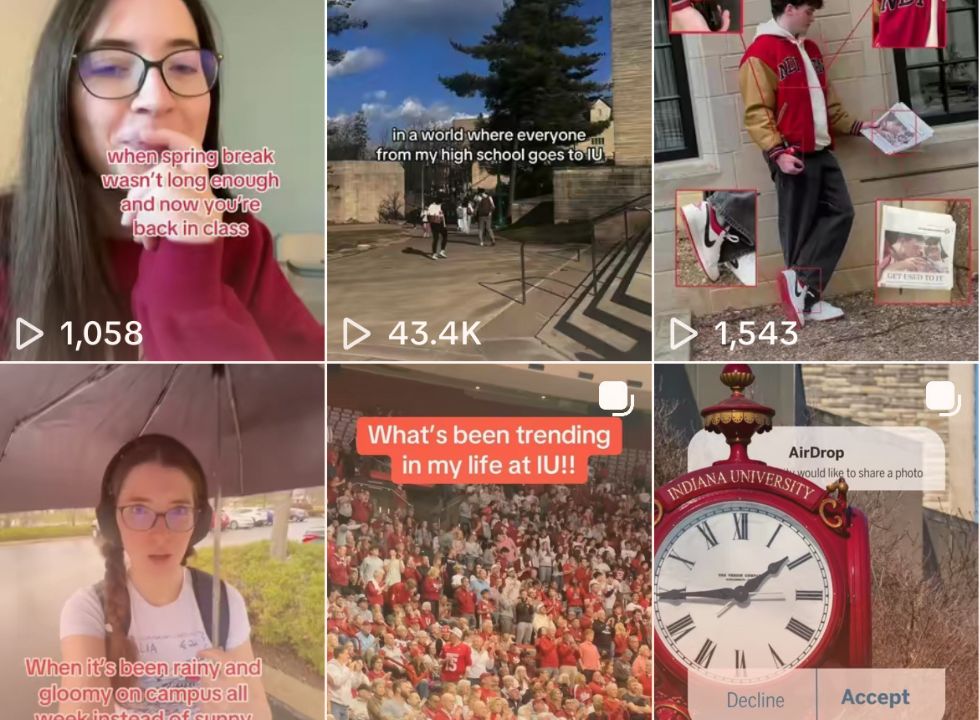
As recently as five years ago, TikTok didn’t exist as an EAA category. Today it’s one of the more competitive content categories in the competition. Gustavus Adolphus College won Gold for TikTok content. Goodwin University won Silver. Iona University won Silver. These aren’t experimental pilots — they’re fully committed channel strategies that institutions deemed worthy of competitive submission.
This matters because it signals a broader shift in educational advertising philosophy: social-native content is no longer being treated as a supplemental tactic bolted onto traditional campaigns. It’s being planned, produced, and evaluated at the same standard as broadcast.
Refuel’s College Explorer™ research quantifies exactly why. College students spend an average of 11.7 hours per week on TikTok — more than any other platform. They are 4.1x more likely to engage with TikTok than the general population. Instagram follows at 10.1 hours per week, YouTube at 11.4. Social platforms collectively dominate student media consumption in ways that no other demographic mirrors.
The College Explorer also reveals that 47% of college students pay most attention to ads that are funny or humorous, followed by “creatively unique” (42%) and “relevant to me” (41%). These are not the characteristics of polished institutional broadcast spots. They’re the characteristics of social-native content — lo-fi, authentic, student-voiced, and culturally aware. The institutions winning Gold in TikTok and social categories understand this implicitly. They’re not repurposing TV spots for the feed. They’re building content that functions in the scroll — short, identity-specific, and worth sharing.
For higher ed marketers still treating social media as a distribution channel for repurposed traditional content, the EAA winners list is a direct challenge to that approach.
Trend 3: LinkedIn Is Emerging as a Serious Graduate and Professional Recruitment Channel
One of the more significant signals in recent EAA competitions is the emergence of LinkedIn as a distinct, award-worthy channel, particularly for graduate and professional programs. Vanderbilt University won a Best of Show designation for its Master of Accountancy LinkedIn campaign. Georgetown University won Gold at the 2026 competition for LinkedIn content as part of a graduate program lead-gen strategy. California State University Northridge Tseng College won Silver for a LinkedIn post.
LinkedIn’s rise in educational advertising reflects a structural reality: graduate and professional students are a fundamentally different audience than traditional undergraduates. They are older, working, career-focused, and making enrollment decisions based on ROI — salary outcomes, employer recognition, career transitions. They live on LinkedIn in a way that traditional undergrads don’t.
Refuel’s university marketing analysis reinforces this segmentation imperative: adult learners, graduate students, military-connected students pursuing advanced degrees, and career-changers require distinct messaging, distinct channels, and distinct creative approaches. Folding them into the same campaign as 18-year-old freshmen is one of the most common and costly targeting errors in higher education marketing.
LinkedIn’s cost-per-lead for highly educated professional audiences, when targeting is tight and creative is relevant, consistently outperforms general programmatic for graduate programs. The EAA’s recognition of LinkedIn campaigns as award-worthy validates what performance data has been showing for several years: this channel belongs in the educational advertising toolkit for any institution running graduate or professional recruitment.
Trend 4: Integrated, Multi-Channel Campaigns Are Pulling Away from Single-Channel Executions
Look at the institutions with the most awards in any given EAA year and a pattern emerges: they’re not winning because of one great ad. They’re winning because their entire campaign ecosystem is coherent.
College of Southern Nevada won six Gold awards in 2024 — for email, outdoor (transit campaign), television series, total advertising campaign, total digital marketing program, and digital video. Every execution was part of one campaign: “Learn More, Earn More.” The message was consistent across every touchpoint. The visual identity was unified. The call to action was clear. Amarillo College won five Golds for a single campaign: “Success is Timeless,” covering radio, television, special events, special promotions, and total digital. Barry University won seven Golds, all extensions of “Break through @ Barry.”
The institutions with one or two isolated entries rarely reach Gold. Integration is the multiplier.
This aligns with what Encoura’s 2026 Digital Marketing Trends for Higher Education identifies as the central attribution challenge in higher ed marketing: students engage across multiple channels before converting, and meaningful attribution requires data to flow across CRM, SIS, and media platforms. Single-channel thinking produces single-channel data — and single-channel data doesn’t explain enrollment decisions.
This is the core case for omni-channel educational advertising strategy: the institutions and brands winning on enrollment are the ones coordinating on-campus OOH, digital, social, direct mail, email, and experiential into a single, coherent audience experience, not running parallel campaigns that happen to share a logo.
Trend 5: DEI and Community-Specific Campaigns Are Growing — Authenticity Separates the Winners
DEI campaigns have become a permanent category in the EAA competition, and the entries are growing in both volume and sophistication. Chaffey College won Gold for “Be a Dreamer/Be Proud” — a campaign directed at DACA and undocumented students. Bucknell University won Gold for an INSIGHT Into Diversity engineering ad. Multiple institutions won for campaigns specifically addressing mental health, racial equality, and community belonging.
The distance between authentic DEI advertising and performative DEI advertising is immediately visible in the work, and judges score accordingly. The winners in this category share a common trait: they’re built with the community, not for it. The creative feels like it comes from inside the institution’s identity, not from a diversity checklist. The talent is real, not stock. The message addresses a specific truth, not a generic affirmation.
This is where Refuel’s approach to multicultural marketing diverges from the standard agency model. Our National University work delivered a 14% increase in Hispanic student prospects against a 5% goal, a 5.3% influencer engagement rate — 4x the industry benchmark, and start rates of 10.5% against a 2.5% benchmark because the campaign was built with cultural precision: the right voices, the right publishers owned and operated by the community, and a messaging framework that addressed the real barriers Hispanic students face. That’s what in-culture advertising looks like when it’s built to perform, not to signal.
For institutions looking to grow multicultural enrollment, the lesson from both the EAA winners and Refuel’s campaign data is the same: authenticity isn’t a creative direction. It’s a research problem. You have to know the audience before you can speak to them.
Trend 6: Out-of-Home Is Underrepresented in Awards — and Overperforming in Results
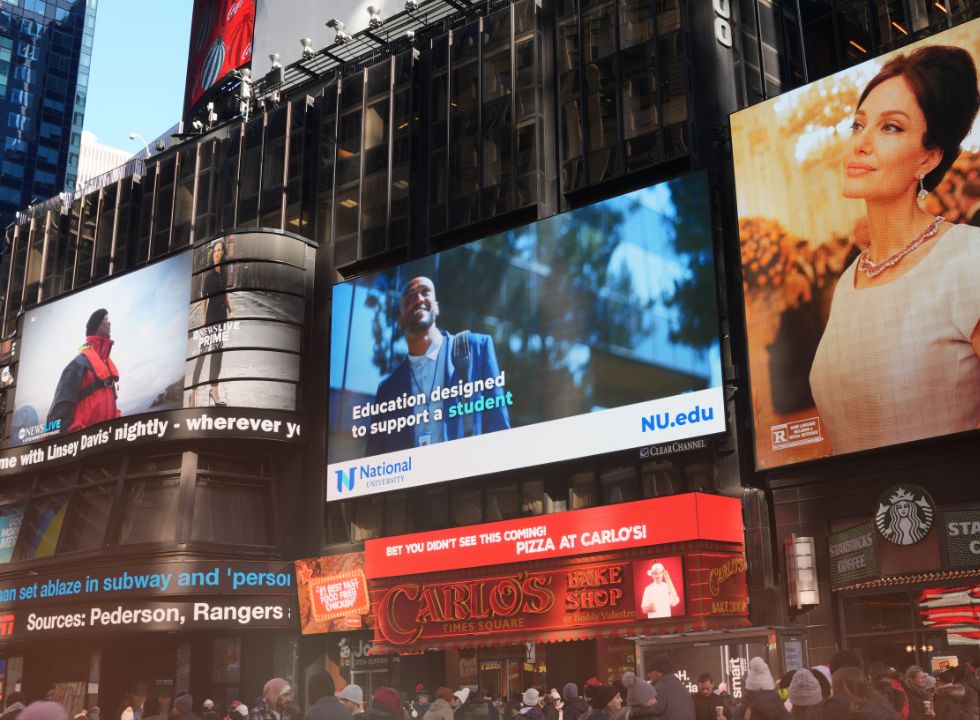
Here’s the most instructive gap in the EAA winners list: outdoor advertising is a small category relative to digital and video. A handful of institutions win Gold for transit campaigns, billboards, and installations each year. But the performance data tells a completely different story.
OOH is underrepresented in educational advertising awards for a straightforward reason: it’s harder to submit. You can’t upload a transit wrap the same way you upload a digital video file. But institutional marketers who are optimizing their strategy around what wins awards are making a costly error. The channels that judge well and the channels that perform well are not always the same.
This is particularly acute for military student recruitment — an audience that is physically concentrated on installations where digital advertising cannot reach them, but where on-base media (fitness centers, dining facilities, digital screens, base newspapers) delivers direct, repeated exposure in the environments where service members make real decisions about their education. No EAA category exists for on-base OOH. That doesn’t make it less effective — it makes it less contested.
Trend 7: Streaming and On-Demand Content Is the Fastest-Growing Format
One of the quietest but most meaningful shifts in the EAA category landscape is the growth of streaming and on-demand content as a distinct entry category. Commonwealth Charter Academy won Gold in 2024 for “Shopping for an Education” — a streaming/on-demand execution. Jackson Academy won Gold for “You Can Soar.” Kent State University won Silver. These are not traditional broadcast spots repurposed for streaming — they’re formats conceived specifically for connected TV and on-demand environments.
The timing tracks with consumer behavior. According to Refuel’s College Explorer, 84% of college students stream video via OTT devices, and they use an average of 4.0 streaming services per household. They are 2.4x more likely to stream on a laptop and 34% more likely to use a smartphone for streaming than the general population. Netflix is used by 84% of college students. Traditional cable, meanwhile, has largely collapsed in this demographic.
For higher education marketers still allocating significant budget to traditional broadcast television, the student audience data is unambiguous: connected TV and streaming-first video strategy is no longer optional. The EAA is starting to catch up with what the data has been saying for years.
The Audience Gap Nobody in Educational Advertising Talks About
Here’s what the EAA winners list doesn’t show: a single campaign built specifically for military students, designed for on-base distribution, or calibrated for the GI Bill-funded learner. In 2,000+ entries from 1,000+ institutions, military student recruitment advertising is essentially absent.
That’s not because military students aren’t a priority. Approximately 820,000 undergraduate students in the U.S. are military-connected, and 42% of Active Duty service members plan to enroll in college within the next six months. It’s because the agencies and in-house teams producing the work that wins at the EAA are not the agencies with on-base access, military research infrastructure, or the cultural fluency to build campaigns that resonate with service members.
The same gap exists in the multicultural student recruitment space. The EAA DEI category is growing, but it’s dominated by general brand-level diversity messaging, not the kind of precision audience work that drives Hispanic or Black American student enrollment at scale.
This is the white space that Refuel’s educational advertising capability is built to fill. Not because the award-winning work doesn’t matter, but because the most important enrollment opportunities in American higher education are sitting in audiences that conventional educational advertising agencies and conventional award categories haven’t learned to address.
What Strong Educational Advertising Looks Like in Practice
Pulling the threads together, the institutions and partners producing the best educational advertising — whether measured by awards or by enrollment outcomes — share a consistent set of principles:
- One platform, executed everywhere. College of Southern Nevada, Barry University, and Colorado State University all won big because their idea was singular and their execution was total. Brand coherence multiplies channel effectiveness.
- Channel strategy follows audience behavior, not habit. TikTok, streaming, LinkedIn, on-campus OOH — the winning institutions are where their students are, not where they used to be.
- In-culture is not in-language. DEI campaigns that win and convert are built from authentic audience understanding, not translated from general market briefs.
- Physical presence still matters. On-campus installations, transit campaigns, and on-base media consistently outperform digital-only strategies in awareness and recall, especially for audiences who live in specific physical environments.
- Measurement has to match the channel. Brand lift studies, UTM tracking, and enrollment attribution models are the tools that validate educational advertising investment when last-click attribution fails.
The 2026 EAB Higher Ed Marketing Outlook found that 61% of enrollment marketing dollars now support digital efforts, but spending growth has stalled, forcing institutions to rethink how they drive visibility and performance. The institutions that outperform in this environment won’t be the ones spending the most. They’ll be the ones targeting the most precisely.
FAQ: Educational Advertising
What is educational advertising?
Educational advertising refers to marketing and advertising created by educational institutions — colleges, universities, K-12 schools — to recruit students, build brand awareness, drive donations, or promote programs. It encompasses everything from traditional broadcast TV and outdoor to digital video, social media content, email, direct mail, viewbooks, and experiential campaigns. The Educational Advertising Awards is the largest national competition recognizing excellence in this discipline.
What formats are winning in educational advertising right now?
Based on recent EAA competitions, the most active and competitive formats are: digital video (short-form brand anthem and testimonial content), TikTok and social-native content, integrated multi-channel campaigns, streaming/on-demand content, and LinkedIn for graduate programs. Out-of-home and on-campus media are underrepresented in awards but consistently outperform in audience research and brand lift studies.
How do you measure the effectiveness of educational advertising?
Effective measurement depends on the channel. Digital educational advertising can be tracked via UTM parameters, CRM integration, and multi-touch attribution. On-campus and out-of-home campaigns are best validated through brand lift studies — measuring aided and unaided awareness, consideration, and intent before and after exposure. Enrollment attribution models that connect campaign exposure to inquiry, application, and yield data give the most complete picture.
What is the difference between educational advertising and enrollment marketing?
Enrollment marketing is the broader strategic discipline of attracting and converting prospective students — encompassing CRM, financial aid strategy, campus visits, and yield management. Educational advertising is the paid media and creative execution component of that strategy: the campaigns, channels, and creative that generate awareness and drive prospective students into the funnel. Strong educational advertising feeds enrollment marketing; it doesn’t replace it.
How do you reach military students through educational advertising?
Reaching military students requires on-base media access (regulated by the DoD and not available to most agencies), military-endemic digital channels (Military.com, Task & Purpose, We Are The Mighty), GI Bill-fluent messaging, and creative that genuinely reflects military identity. Advertising directly influences 26% of Active Duty college enrollment decisions — more than admissions counselors or printed brochures. Refuel’s MilitaryScapes™ network provides the on-base infrastructure most educational advertisers lack entirely.
What makes multicultural educational advertising effective?
Effective multicultural educational advertising is built on audience research, not creative assumptions. It identifies the specific barriers each community faces — for Hispanic students, cost and institutional support are the top two — and builds messaging to address those barriers through culturally authentic voices and community-owned media. Translating general market creative into Spanish is not multicultural advertising. See Refuel’s multicultural marketing approach for what in-culture strategy looks like in practice.
The Bottom Line

The EAA winners list is one of the best annual benchmarks in higher education marketing. It shows where the field’s creative energy is flowing, which formats are maturing, and which institutions are investing seriously in their brand. But the awards don’t capture the full picture of where educational advertising’s most important work is being done — or where its most significant enrollment opportunities still go unmet.
The institutions and brands that outperform on enrollment aren’t always the ones with the most awards. They’re the ones that understand their specific audiences deeply enough to build campaigns that speak to them with precision — in the right channels, with the right message, in the right cultural register.
That’s the work Refuel has been doing for 35+ years: building educational advertising strategies for the students that conventional campaigns miss. Whether you’re recruiting military learners, growing Hispanic and Black American enrollment, or building a Gen Z pipeline from high school through graduation, the audience is reachable — if you have the access, the research, and the strategy to get there.
Ready to build an educational advertising strategy that moves enrollment numbers?