
America’s 65 million Hispanic consumers represent one of the most powerful, and most misread, audiences in modern marketing. Their collective spending power has reached $3.78 trillion. Their GDP contribution would rank 5th among world economies. Their population is projected to more than double to 111 million by 2060. Yet most brands still reach them with translated English ads, generic multicultural creative, or one-size-fits-all campaigns that collapse a richly layered community into a demographic checkbox. Cultural customization — the strategic practice of tailoring messaging, creative assets, media channels, and the entire consumer experience to reflect specific values, language preferences, and cultural identity — is the difference between a brand that earns trust and one that gets ignored.
This playbook is built on Refuel Agency’s proprietary Hispanic Explorer™ research, the most comprehensive ongoing study of U.S. Hispanic consumers by acculturation level, generation, and media behavior. It’s the foundation we use to drive measurable performance for brands trying to reach the hardest-to-reach consumers in America.
Why Cultural Customization Is Non-Negotiable for Hispanic Marketing
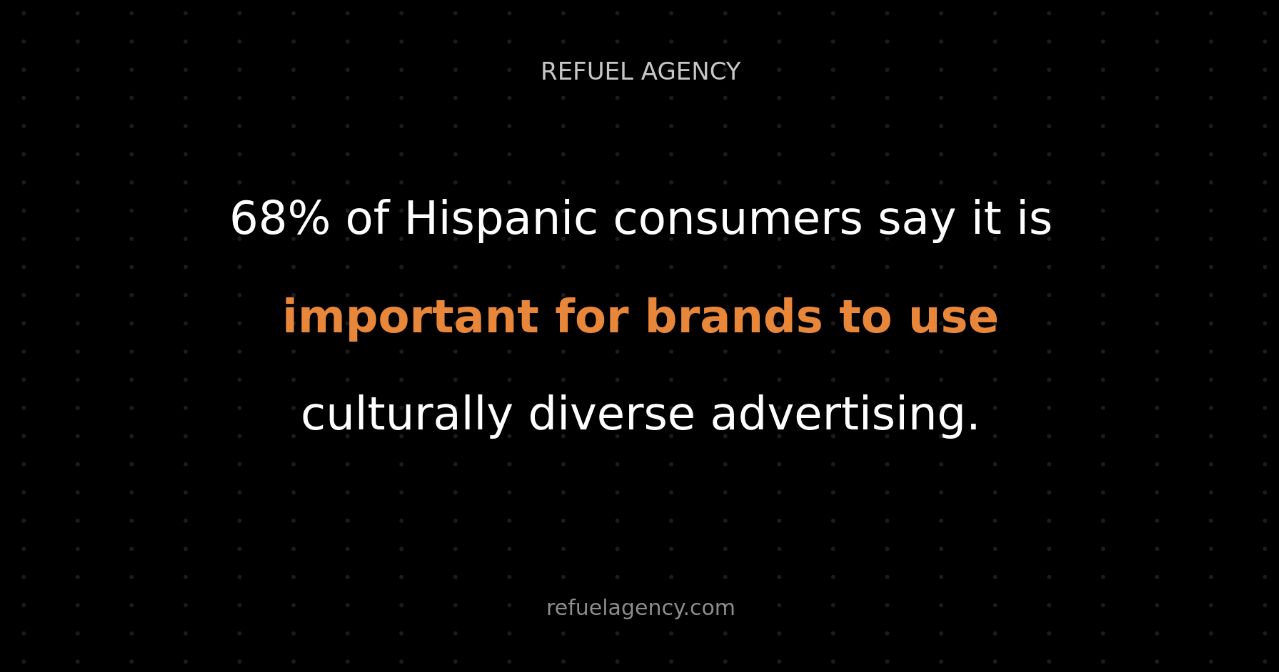
Most brands underestimate how much is at stake when they get this wrong. According to Refuel’s Hispanic Explorer research, 68% of total Hispanics say it is important for companies to create culturally diverse advertising in order to stay relevant. That number rises to 73% among unacculturated Hispanics. When an advertisement reflects Hispanic culture, 61% of unacculturated Hispanics are more likely to try the advertised brand, 14% more than the total Hispanic average.
The mechanism behind this is trust. Culturally aligned creative reduces friction and increases perceived authenticity, which lifts attention, engagement, and downstream conversion. For Hispanic consumers who span a wide range of acculturation levels and language preferences, cultural relevance is the filter that determines whether a brand earns a relationship or gets scrolled past. Bicultural Hispanics alone account for 68% of total Hispanic spending power, approximately $1.48 trillion. Reaching them authentically isn’t a diversity initiative; it’s a growth strategy.
The Acculturation Framework: One Audience, Multiple Entry Points
The most costly mistake in Hispanic marketing is treating “Hispanic” as a monolith. Refuel’s Hispanic Explorer research identifies three primary acculturation segments, each requiring a meaningfully different approach.
Unacculturated Hispanics
Approximately 18% of the Hispanic population, this segment relies heavily on Spanish-language media and maintains deep ties to their heritage. They are 4.9x more likely to engage with Hispanic-specific media than acculturated Hispanics, and their trust leans strongly toward Hispanic TV, community radio, and local print. They visit barbershops 13% more frequently than total Hispanics and shop at Hispanic-owned businesses at significantly higher rates. Reaching them requires showing up in the environments they already frequent and trust.
Bicultural Hispanics
At approximately 68% of the Hispanic population, this is the strategic center of gravity for most campaigns. Bicultural consumers live comfortably in both worlds: proud of their heritage, fluent in English and Spanish, and equally trusting of Hispanic and general market media. They hold the highest spending power of any acculturation segment. When advertising reflects their culture, Millennial Hispanics in this group are 20% more likely to pay attention than the total Hispanic average. They are also the most cause-responsive segment, with strong purchase intent for brands that support issues they care about.
Acculturated Hispanics
Approximately 14% of the Hispanic population, this segment has the highest household income, averaging $111,984 (30% above the overall Hispanic average). They skew toward English-language content and general market media, but still over-index on purchase intent in categories like automotive, fine jewelry, and electronics. Earned credibility through community signals and peer endorsement matters more to this group because their overall media trust is lower across the board.
The practical implication is straightforward: your campaign architecture should be built around acculturation, not just age or geography. A single creative execution will not resonate equally across all three segments, and a single media buy will not reach them all effectively.
Language Is Infrastructure, Not Just Creative
One of the most consistently underestimated dimensions of cultural customization is language continuity across the full consumer journey. Refuel’s Hispanic Explorer data shows that acculturated Hispanics direct 87% of their ad attention toward English-only content, while unacculturated Hispanics pay nearly equal attention to ads in both English and Spanish. Bicultural Hispanics sit in between, responsive to both depending on context and channel.
Where most brands break down is not in the ad itself; it’s in what happens after the click. The ad is in Spanish, the landing page is in English, the checkout flow has no language option, and the customer service line doesn’t have Spanish-speaking agents. That disconnect doesn’t just reduce conversion rates. It signals to the consumer that the cultural effort was performative, and Hispanic consumers, who are sophisticated and frequent media consumers, notice.
Effective cultural customization demands end-to-end language continuity. If your ad creative is in Spanish, the linked website, the checkout flow, the customer service line, and any follow-up communications need to match. This is not a content problem; it’s a structural one. Solving it is one of the clearest competitive advantages available to brands willing to invest in multicultural marketing solutions.
In-Culture Media Placement: Reaching Hispanic Audiences Where They Already Trust
Cultural customization also determines where you show up, not just what you say. Hispanics visit local grocery stores and supermarkets an average of 12 times per month, making them 8% more likely to visit grocery environments than the general population. They are 55% more likely to visit convenience stores than the general population and visit local Hispanic-owned businesses at rates significantly above the total market.
Placing media in environments where Hispanic consumers already spend time and already trust, including their own grocery stores, Hispanic-owned businesses, barbershops, and community centers, generates a fundamentally different quality of attention than a digital impression served outside that trusted context. This is what out-of-home advertising for Hispanic audiences can accomplish that digital-only campaigns cannot: physical presence in culturally familiar spaces.
Unacculturated Hispanics are also 13% more likely to visit barbershops than total Hispanics, visiting them nearly 9 times per month. These aren’t just retail environments; they’re community hubs. For brands serious about cultural customization, they represent trusted media placements that no programmatic buy can replicate.
The Bicultural Bridge Generation: The Audience Most Brands Miss
Among the most strategically significant findings from Refuel’s Hispanic Explorer research is the role of bicultural Hispanic adults in their 40s, typically Gen X, who function as decision-makers for both their aging parents and their children. They are firmly embedded in both American and Hispanic culture, fluent in both languages, and positioned at the intersection of two generations of household purchasing decisions.
These consumers don’t need to be convinced to engage with American brands; they already do. But they are also the gateway to multi-generational household purchases, including healthcare, financial products, insurance, automotive, and home improvement. They navigate the needs of unacculturated parents and acculturated children simultaneously, often serving as interpreters, both literally and figuratively, between cultures and between generations.
Reaching this segment requires creative that honors the duality of their identity without flattening it. It requires media placement that respects both their general market consumption habits and their ongoing connection to Hispanic media. And it requires year-round consistency; brands that only engage during Hispanic Heritage Month are not building the sustained presence this audience recognizes as genuine.
Trust Architecture: Where and How Hispanic Consumers Receive Brand Messages
Refuel’s research maps media trust by acculturation level, and the findings are actionable. Unacculturated Hispanics are 3x more likely to trust Hispanic-specific media than acculturated Hispanics. Bicultural Hispanics show near-equal trust toward Hispanic and general market media, making them reachable across both ecosystems but requiring investment in both. Acculturated Hispanics show lower overall media trust, which makes earned credibility through community voices, influencers, and peer endorsement especially valuable for this segment.
Social media reaches 83% of all Hispanic consumers and is the top attention-capturing ad format, with 55% of total Hispanics paying attention to social media ads compared to 40% for cable TV. But the channel preferences diverge by acculturation. Unacculturated Hispanics over-index on social media as a source of political, product, and community information. Acculturated Hispanics lean more toward online video. Across all segments, YouTube over-indexes versus the general population, and AM/FM radio reaches Hispanics at rates 7% higher than the general market.
For a deeper breakdown of the media channels that drive engagement across acculturation segments, Refuel’s Hispanic Explorer study provides the full data set.
Cause Alignment: Values Drive Purchase Intent
Cultural customization in advertising also extends to brand values and what your brand stands for publicly. Refuel’s Hispanic Explorer research found that 50% of total Hispanics are likely to try brands that support causes or issues they care about, with Millennial Hispanics 13% more likely than the total Hispanic average to act on that preference. Bicultural Hispanics are the most cause-responsive acculturation segment.
Top causes among Hispanic consumers include environmental stewardship, access to affordable healthcare, women’s rights, and community welfare. Unacculturated Hispanics over-index significantly on environmental values, with 83% saying preserving the environment is important (27% more likely than the general population). Family and friends remain the most trusted source of information about causes at 48%, which means community-level activation and word-of-mouth amplification often outperform paid media for driving genuine cause-related engagement.
The implication for brands is clear: cause alignment in Hispanic marketing is a purchase driver, not just a reputation lever. Campaigns that authentically connect brand values to the causes Hispanic consumers already support generate measurably higher intent. The key word is authentically. Hispanic consumers will distinguish between performative brand activism and genuine, ongoing commitment.
Platform Strategy by Acculturation Segment
Understanding where each segment spends their time, and what kind of content resonates in each environment, is the foundation of a channel strategy built on cultural customization.
Unacculturated Hispanics respond best to social media ads (67% pay attention), Hispanic TV (trusted by this segment at 3x the rate of acculturated Hispanics), community radio, and in-culture environments like grocery stores and Hispanic-owned businesses. For this segment, Spanish-language creative paired with in-culture placement is the highest-performing combination.
Bicultural Hispanics are reachable across both Hispanic and general market channels, with social media ads (54% attention), cable TV (40%), and billboards (35%) all performing well. This segment is also the most likely to notice out-of-home advertising and respond to brand messaging in high-traffic community locations. Creative that reflects both cultural dimensions, without choosing one identity over the other, will consistently outperform English-only or Spanish-only approaches.
Acculturated Hispanics over-index on online video ads (44% attention, higher than both other segments), streaming devices, and general market digital environments. For this group, cultural customization is less about language and more about representation, narrative authenticity, and demonstrating genuine familiarity with their lived experience.
For more on building a multicultural marketing strategy across all three segments, Refuel’s team of specialists can walk through a channel plan tailored to your specific categories and objectives.
What Refuel Brings to Hispanic Cultural Customization
Refuel Agency’s Hispanic and multicultural practice operates under Influyente, a dedicated multicultural marketing agency powered by the Hispanic Explorer™ research series, 8,500-plus publisher relationships, and omnichannel capabilities that span digital, in-store, community, and broadcast environments.
Our approach to cultural customization rests on three pillars. First, proprietary research: the Hispanic Explorer™ study delivers annual, acculturation-segmented data on media habits, purchase behavior, ad responsiveness, trust, and cultural values. This is not syndicated data; it is purpose-built intelligence for brands trying to reach Hispanic consumers with precision. Second, omnichannel execution: we reach Hispanic consumers where they already are, including Hispanic TV and radio networks, Spanish-language digital media, in-store environments, community events, and social platforms. Third, end-to-end cultural fluency: from creative strategy through media placement to user experience design, we ensure that cultural customization is a throughline across the entire consumer journey, not just the ad unit.
Refuel’s multicultural playbooks are proven across nearly half of the Fortune 500, with clients reporting 9-10% year-over-year campaign growth and 27-29% margin efficiency.
Frequently Asked Questions
What is cultural customization in Hispanic marketing?
Cultural customization means adapting your brand’s messaging, creative, media channels, and consumer experience to reflect the specific values, language preferences, and cultural identity of Hispanic consumers, segmented by acculturation level, generation, and community. It extends far beyond translation to include trust architecture, in-culture media placement, and end-to-end language continuity across the full consumer journey.
Why does acculturation matter for Hispanic marketing strategy?
Acculturation determines how Hispanic consumers engage with media, what language they prefer in advertising, which channels they trust, and what motivates them to purchase. Unacculturated, bicultural, and acculturated Hispanics have meaningfully different media habits and ad responsiveness patterns. Campaigns built on acculturation-segmented insights consistently outperform those that treat the Hispanic audience as a single demographic.
What does in-culture media placement mean in practice?
In-culture media placement means reaching Hispanic consumers through channels and environments they already trust: Hispanic TV networks, Spanish-language radio, community grocery stores, Hispanic-owned businesses, and social platforms where Hispanic communities are organically active. It is the difference between interrupting a consumer with an ad and showing up where they already feel at home.
How important is language consistency across the consumer journey?
It is foundational. If your ad is in Spanish but your website is in English and your customer service line has no Spanish-speaking agents, you are breaking the trust your creative worked to build. Language continuity across every touchpoint, from ad to landing page to checkout to customer service, is a core requirement of effective cultural customization.
Who is the bicultural bridge generation and why do they matter?
Bicultural Hispanics in their 40s occupy a unique position as household decision-makers for both their parents’ generation and their children’s. They navigate both cultures fluently, consuming Hispanic and general market media, and they control purchasing decisions across high-value categories including healthcare, financial products, insurance, and automotive. Reaching them requires creative and media strategies that honor both dimensions of their identity simultaneously.
The Hispanic market is not a segment to add to your campaign plan at the end of Q3; it is a primary growth driver that most brands are significantly underinvesting in. With $3.78 trillion in spending power, a population growing faster than any other group in the country, and a documented preference for brands that show up authentically in their culture, the opportunity is well-defined and the data is available to act on it now.
Refuel Agency combines $1M-plus in proprietary research, 8,500-plus publisher relationships, and 35-plus years of proven multicultural marketing execution to help brands reach Hispanic consumers with the precision and cultural intelligence this audience demands.
Contact Refuel Agency to learn how our Hispanic Explorer™ research and Influyente™ platform can drive measurable growth with America’s most powerful multicultural audience.
