
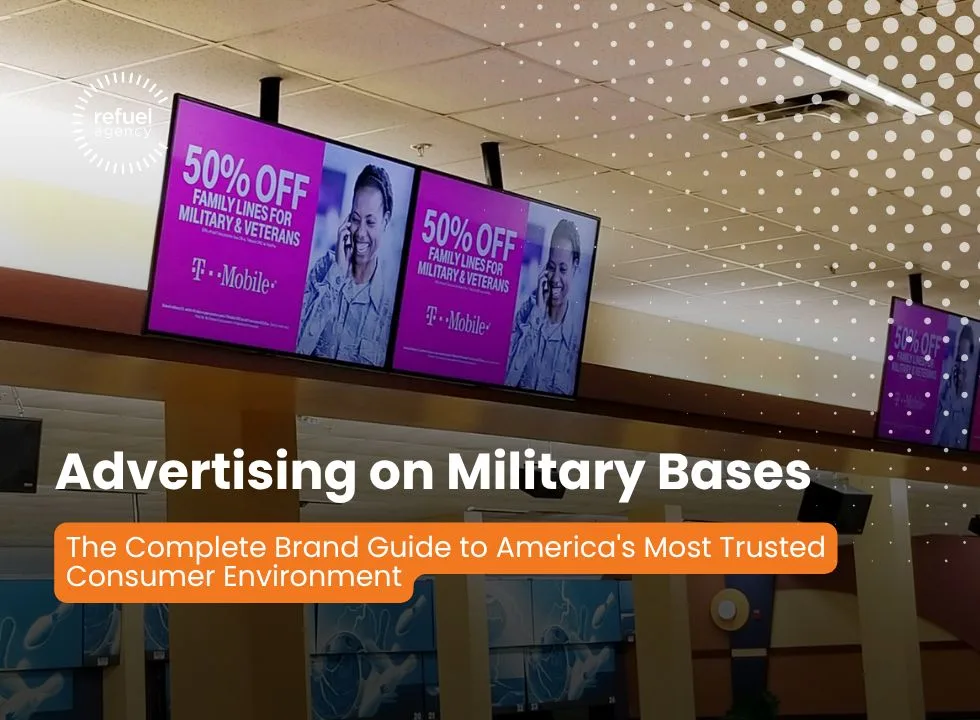
Advertising on military bases is not like advertising anywhere else in the United States. The audience is concentrated, verified, high-income, and community-bound in a way that no shopping mall, sports venue, or digital platform can replicate. When a service member sees your brand on the gym wall they visit 17 times a month, at the commissary they frequent more than a dozen times per month, and in the dining facility where they eat with their unit, that repeated, in-context exposure builds brand trust at a pace that off-base media simply cannot match. For brands in insurance, financial services, automotive, education, telecom, consumer goods, and healthcare, advertising on military bases represents one of the highest-return audience investments in American marketing, if the strategy, access, and creative are executed correctly. This guide covers everything your brand needs to know: the audience, the access requirements, the media formats, the compliance rules, the performance data, and the case studies that prove the ROI.
The Military Market: A Consumer Audience Most Brands Underestimate
The U.S. military community comprises 43 million consumers: 1.3 million Active Duty members, 600,000 Active Duty spouses, 6.2 million Post-9/11 veterans, and 3.8 million veteran spouses. Collectively, they represent $471.5 billion in spending power, according to Refuel Agency’s 2025/26 Military Explorer study. That figure rivals the combined buying power of many individual states, yet the military market consistently ranks among the most underinvested consumer segments in media planning, largely because most agencies lack the access infrastructure and audience intelligence to reach them where they actually live and make decisions. Refuel-Military-Explorer-Study-2025_26-Highlights.pdf
The income data frames why this audience warrants brand investment at the highest level. Active Duty members carry an average household income of $126,200 (single) and $138,100 (married). Active Duty spouses average $162,800 in household income. Post-9/11 veterans average $131,300 (single) and $150,500 (married). These are not entry-level consumers. They are prime-age, dual-income households with stable government employment, structured benefits packages, and spending patterns concentrated in automotive (the single largest category at $35.5B for Active Duty alone), home improvement, electronics, clothing, and personal accessories. They also move frequently: 81% of Active Duty members and their spouses have relocated one to five times due to military obligations, with an average residency of 32.4 months before the next Permanent Change of Station (PCS). That relocation cadence means the military audience is in active consideration for auto, banking, insurance, internet, and housing products more often than any other comparable consumer segment. Refuel-Military-Explorer-Study-2025_26-Highlights.pdf
The trust and brand loyalty dynamics of this community are equally important for advertisers to understand. Trustworthiness is the top personal value among Active Duty members, with 97% ranking it first. Customer service is the primary driver of purchase decisions and brand loyalty for 67% of Active Duty consumers. Brands that demonstrate respect for military service through on-base presence and authentic engagement earn loyalty that carries across every subsequent duty station and into the veteran years. Brands that advertise only off-base or only in general market channels miss the community-endorsement signal that drives this audience’s strongest purchase decisions. Refuel-Military-Explorer-Study-2025_26-Highlights.pdf
What Advertising on Military Bases Actually Means
Advertising on military bases is a catch-all term for a diverse media ecosystem that operates on federally regulated installations across the United States and internationally. The DoD does not allow unrestricted commercial advertising on its facilities; all on-base advertising operates through approved channels administered by the Morale, Welfare, and Recreation (MWR) program, the Army and Air Force Exchange Service (AAFES), the Navy Exchange (NEX), and Marine Corps Exchange (MCX). Each installation has its own command authority, and each branch has specific guidelines for which ad categories are permitted, what creative standards apply, and what approval timelines look like. mccoy.armymwr
The practical implication is that advertising on military bases is not a self-service media buy. It requires institutional relationships with installation commands, category-specific approvals (financial services, automotive, alcohol, and healthcare all carry distinct compliance requirements at the branch and installation level), creative review and sign-off before any placement goes live, and in some cases, ongoing relationship management with MWR and exchange program administrators. This is precisely why brands that attempt on-base advertising without an experienced partner frequently encounter delayed launches, compliance rejections, or placements that fail to generate results because they were placed in low-traffic locations without audience intelligence informing the selection. Casse-Studies-Master.pdf
Refuel’s MilitaryscapesTM network is the largest scaled, approved on-base commercial media infrastructure in the United States, built over 37 years of installation-level relationships, category-compliance expertise, and proprietary audience research. It is the access infrastructure that made it possible for Anheuser-Busch (one of the few alcohol brands in history to receive on-base advertising approval) to execute compliant, age-gated campaigns for Budweiser, Bud Light, and Michelob Ultra across multiple installations. Navigating DoD guidelines for an alcohol advertiser required base-by-base command approvals, custom creative compliance, and a regional market rollout framework that no general market OOH vendor could have executed. The campaign delivered high CTRs, positive brand lift, and was extended beyond its original timeline due to strong performance and regional demand. Casse-Studies-Master.pdf
On-Base Media Formats: What Is Available and Where It Performs
The on-base media ecosystem offers more format diversity than most media planners realize. Refuel’s MilitaryscapesTM OOH network spans content board networks in family centers, fitness facilities, transition offices, and gaming rooms; posters and banners; flyers; digital screens; base newspaper print placements; direct mail to on-base and BAH (Basic Allowance for Housing) addresses; and experiential activations including Ride and Drive events, branded vehicle wraps, and in-community product demonstrations. Each format targets a specific audience segment and facility type, and the most effective advertising on military bases programs combine multiple touchpoints across the same installation to create a surround-sound brand presence. refuelagency
Fitness Center and Gym Advertising
The on-base fitness center is the highest-traffic facility on any installation. Active Duty members visit the gym an average of 17.1 times per month, Active Duty spouses 16.3 times, and Post-9/11 veterans 15.6 times. No other location, on-base or off, produces that frequency of audience contact with the same individual. Brands in fitness equipment, nutrition, supplements, telecom, automotive, banking, and insurance consistently achieve the highest frequency exposure in the gym environment, which is why fitness center content boards and digital screen placements represent some of the most competitive on-base inventory. GEICO’s seven-year, 200-base on-base program specifically secured long-term real estate in fitness centers and transit environments to establish what Refuel describes as “real estate-like brand ownership” within the military community. That sustained fitness center presence, combined with digital screen placements, drove year-over-year policy increases directly correlated with on-base investment and established GEICO as USAA’s top competitor in the military insurance market.Casse-Studies-Master. pdf+1
Commissary and Exchange Advertising
The commissary (on-base grocery store) and the PX/BX/NEX/MCX (on-base retail exchange) represent the second and third highest-frequency on-base visits, with Active Duty members visiting the commissary approximately 13.3 times per month and the exchange approximately 13.5 times monthly. In-store and proximity advertising in these environments places the brand message at the point of the shopping decision, not in a passive viewing context. For consumer goods brands, food and beverage brands, and personal care brands seeking military audience penetration, exchange and commissary proximity advertising delivers point-of-purchase reach that is structurally unavailable through any digital channel. Refuel-Military-Explorer-Study-2025_26-Highlights.pdf
Digital Out-of-Home (DOOH) and Content Board Networks
Digital screens positioned across family service centers, transition offices, gaming rooms, and dining facilities create a multi-touchpoint, high-dwell brand environment. The transition office is a particularly strategic DOOH placement for financial services, education, and automotive brands, because service members preparing to transition out of the military are in active consideration for civilian banking, insurance, vehicle financing, and degree programs. They have both the financial assets (TSP balances, VA loan eligibility, GI Bill benefits) and the motivated decision-making mindset to respond to well-positioned advertising at the moment of life stage transition. American Public University System (APUS) leveraged Refuel’s on-base OOH network (including transition office and high-visibility campus-style placements) to achieve a 63% net lift in website visitation, 2.6 times the average benchmark, with a 64% lift in priority markets including Jacksonville, Raleigh, San Diego, and Waco. Casse-Studies-Master.pdf
Base Print and Direct Mail
Base newspapers maintain a readership loyalty within military communities that is not replicated in civilian media markets. The on-base print product is read by the community for which it is produced, and the ad context (community events, base news, unit announcements) makes commercial placements more contextually native than general market print. Refuel’s data shows base print newspaper consumption at 84% among Active Duty members (a few times per month or more), with Active Duty members 6% more likely to consume it than the total military audience average. For USAA, Refuel sustained $2 million in annual print media through base newspaper placements for more than 20 years, with the relationship evolving from print into digital audience targeting and full managed service exploration. Casse-Studies-Master. pdf+1
Experiential and On-Base Events
On-base experiential activations including Ride and Drive events, product demonstrations, sampling programs, and sponsored on-base activities create the community participation moments that earn the deepest brand trust from military audiences. BMW’s Military Incentive Program used on-base Ride and Drive activations at the Military Influencer Conference, the Marine Corps Marathon, and key base events, layered with geo-targeted programmatic digital and verified military audience social media. The result was 10 million in campaign reach, 300% influencer overperformance (driven in part by a viral video campaign with US Army veteran and race car driver Courtney Jane Casale, which generated 2.6 million video plays and more than 1 million views in its first month), and 30% growth in military sales, with total investment growing 850% from year one. Casse-Studies-Master.pdf
The Compliance Framework Brands Cannot Ignore
Advertising on military bases operates within a multi-layer compliance framework that differs by advertiser category, by branch, and in some cases by individual installation. The Army’s MWR Sponsorship and Advertising program requires that all on-base advertising personnel have completed annual sponsorship training and ethics training, and that they hold written authorization from installation command representatives. The Navy’s regulatory framework (32 CFR § 705.13) requires that all commercial advertising layouts, artwork, and text be submitted for review and clearance before placement. Categories such as alcohol, financial services, and healthcare carry additional review requirements because of federal regulations governing advertising to uniformed personnel. law.cornell+1
The creative requirements for advertising on military bases are equally specific. Military branch trademarks and service marks cannot be used in commercial advertising without explicit written permission from the relevant branch trademark licensing office. Depictions of uniformed military personnel in ads must meet DoD guidelines about rank insignia visibility and clear unit identification. Any ad copy that implies DoD endorsement of a commercial product is prohibited, including language that could be read as suggesting the government recommends or endorses a brand. These requirements are not optional suggestions; compliance failures can result in removal of all placements, category bans from the installation, and reputational damage with the military community that takes years to repair. army+1
For brands working with Refuel, the compliance infrastructure is embedded in the campaign planning process. Refuel handled base-by-base approvals and creative compliance for the Anheuser-Busch on-base campaign, securing compliant placements for alcohol brands in a category that had essentially no documented precedent for on-base commercial advertising. For Navy Federal Credit Union, Refuel provided custom disclaimers and secured base-by-base approvals in the highly restricted financial services category, growing NFCU’s on-base footprint from 8 bases to 20 and unlocking high-impact inventory that became available following GEICO’s exit from certain placements. Casse-Studies-Master.pdf
Why On-Base Advertising Outperforms Off-Base Channels for This Audience
The performance differential between advertising on military bases and off-base digital targeting is not theoretical. It is documented at the brand perception level in Refuel’s 2025/26 Military Explorer research, and validated at the business outcome level across multiple long-term client campaigns. Refuel-Military-Explorer-Study-2025_26-Highlights.pdf
On the perception side, 72% of Active Duty members are more likely to try a brand after seeing its ads on-base, compared to seeing those same ads off-base. 68% report a deeper brand connection when they see on-base advertising versus off-base. And 68% are more likely to recommend a brand to others after on-base ad exposure. These are not passive awareness metrics. They are purchase influence and word-of-mouth advocacy metrics, and they demonstrate that on-base advertising generates a qualitatively different brand response than digital advertising served outside the installation perimeter. For a community defined by its shared service identity (86% of Active Duty and 83% of veterans consider their military experience a “somewhat” or “most important” part of their personal identity), advertising on military bases signals respect and community investment in a way that generic national campaigns fundamentally cannot. Refuel-Military-Explorer-Study-2025_26-Highlights.pdf
On the business outcome side, the documented results across Refuel’s client base make the performance case concrete:
GEICO grew from a few pilot bases and $200,000 in initial spend to a seven-year, 200-base national program, with year-over-year policy increases directly correlated with on-base investment, ultimately establishing the brand as USAA’s primary military market competitor. Casse-Studies-Master.pdf
BMW grew its military sales by 30%, with investment expanding 850% from its year-one test budget to a $3.1 million total program, driven by a combination of on-base experiential events, verified military digital targeting, and influencer content calibrated for the military community’s trust signals. Casse-Studies-Master.pdf
APUS achieved a 63% net lift in website visitation from on-base OOH, 2.6 times the industry average, and a 64% brand lift in four priority military markets, validated by a brand lift study commissioned specifically to prove campaign value in an environment where pixel attribution was structurally unavailable. Casse-Studies-Master.pdf
T-Mobile built a multi-year, multi-audience military partnership with Refuel that combined on-base print with digital pre-roll, endemic platform takeovers, email, and social. The campaign used on-base print as the cultural anchor, establishing a brand presence within the military community before expanding the engagement through digital touchpoints calibrated to each military audience segment. Casse-Studies-Master.pdf
Fox Nation turned a one-week Memorial Day test (a free year of Fox Nation for verified military members) into a multi-year, multi-audience campaign that included on-base distribution (base gyms, inboxes, and waiting areas), experiential activations, and direct mail to verified veterans. The campaign drove all annual verification goals in one week, with the original campaign meeting its full-year KPI within days of launch, then extended to first responders and students. Casse-Studies-Master.pdf
Pairing On-Base Advertising With Digital Targeting for Full Audience Surround
The highest-performing military marketing programs treat advertising on military bases not as a standalone channel but as the physical anchor of a multi-channel strategy. On-base OOH and experiential establish the brand as a community presence that service members see, trust, and associate with their daily environment. Digital channels (geofenced programmatic, social media, email, endemic military publishers, and streaming audio) extend the on-base brand signal into the hours the audience spends off-base and online, reinforcing the brand relationship and driving conversion-stage behavior.
Refuel’s digital military marketing solutions include geo-fenced digital reach targeted to on-base device pools, programmatic display through the Military Audience Network, social campaigns calibrated to the military community’s platform preferences (YouTube and Facebook at 90% and 73% monthly usage rates respectively among Active Duty, with TikTok used by 61%), email to verified military segments, and endemic content placement across Task Purpose, We Are The Mighty, Military.com, and other high-trust military publishers. Refuel-Military-Explorer-Study-2025_26-Highlights.pdf
The importance of digital integration is reinforced by Refuel’s 2025/26 Military Explorer data showing that Active Duty members show nearly equal consumption of traditional and digital media (48% traditional, 52% digital), and that on-base OOH scores 9.4 out of 10 on a frequency-of-consumption scale, comparable to satellite radio and basic cable TV. On-base OOH is consumed at the same rate as the most heavily used traditional media in this audience’s life, making it a foundational media placement, not a supplementary one. Refuel-Military-Explorer-Study-2025_26-Highlights.pdf
The geofencing advertising layer is particularly important for on-base campaigns because it allows the on-base OOH impression to be followed by a targeted digital ad served to the same device after it leaves the installation perimeter. Service members who saw the APUS on-base OOH were reached again through geo-targeted digital placements as they went about daily life off-base. That retargeting layer is what lifted website visitation metrics above 2.6 times the benchmark: the on-base OOH created the initial brand recognition, and the digital follow-through captured the conversion intent when the audience had time and connectivity to act on it.
Industries That Win With On-Base Advertising
Certain categories have a structural advantage in advertising on military bases because the audience’s financial behavior and life stage align directly with those categories’ core use cases. Understanding where the spending goes is the starting point for building a category-specific investment case.
Automotive is the single largest discretionary spend category for every military audience segment: Active Duty ($35.5B), Active Duty spouses ($18.7B), and Post-9/11 veterans ($178.5B) all rank automotive first. The PCS relocation cycle (an average of every 32.4 months) forces repeated vehicle purchase decisions, and military-specific incentive programs (through OEM Military Advantage programs) give brands like BMW the offer structure to generate premium conversion rates with this audience. Automotive brands advertising on military bases and pairing on-base presence with verified military digital have the strongest documented ROI in the category. Refuel-Military-Explorer-Study-2025_26-Highlights.pdf
Financial services and insurance rank second in strategic importance because of the life-stage intensity of military financial decisions: PCS moves trigger banking transitions, deployments require life insurance reviews, vehicle purchases require auto insurance, and the VA loan eligibility that service members carry is the most powerful home-buying asset available to any consumer segment. GEICO and USAA both built their military market share through sustained on-base advertising. Navy Federal Credit Union used on-base OOH and print to expand from a Navy-only brand to a military community-wide financial institution, growing its on-base footprint from 8 to 20 bases under Refuel’s management and achieving a 3x expansion of its target audience definition. Casse-Studies-Master.pdf
Higher education is the third highest-priority vertical for advertising on military bases, driven by GI Bill eligibility, tuition assistance programs, and the 65% of Active Duty members who have completed at least some college. Post-9/11 veterans show particularly strong education intent: 43% check for the availability of online classes when researching colleges. APUS built a seven-year on-base advertising relationship with Refuel that evolved from a single-brand AMU active duty focus to a multi-brand program covering AMU, APU, and Rasmussen University, targeting active duty, spouses, and civilian learners, all validated through brand lift research that proved campaign value when enrollment pixel attribution was structurally limited.Refuel-Military-Explorer-Study-2025_26-Highlights. pdf+1
Telecom, healthcare, consumer goods, and home improvement round out the top advertising categories for the military market. T-Mobile’s multi-year partnership with Refuel expanded from military to college, first responders, healthcare workers, and educators, with the on-base military campaign serving as the brand’s proof-of-concept for how niche audience investment builds multi-audience platform momentum. Casse-Studies-Master.pdf
What Brands Get Wrong When Advertising on Military Bases
The most common failure mode in advertising on military bases is not a compliance issue or a media placement problem. It is a cultural authenticity deficit. Brands that repurpose general market creative for on-base placements without adapting the imagery, language, offer structure, or proof points to the military context produce impressions without connection, and in a community defined by shared identity, the lack of cultural fluency is noticed.
Renewal by Andersen is a documented example of this failure mode. The brand came to Refuel running a $500-off military promotion that used general market creative and offer language, with the discount positioned as a cause-marketing gesture rather than a genuine military community benefit. Refuel rebuilt the military program from scratch: reworking the offer structure, standardizing eligibility language for service member clarity, integrating SheerID for verification, conducting a market-by-market audience analysis across 20 dealer territories, and producing an influencer campaign with HGTV talent Shane Duffy that spoke to military homeowners in a culturally credible voice. The result was a campaign that outperformed the brand’s existing Wounded Warrior Project cause-marketing partnership on every measurable dimension. Casse-Studies-Master.pdf
The second most common failure mode is operating without proper installation relationships and attempting to navigate base access through indirect channels. On-base advertising requires direct relationships with MWR directors, exchange program administrators, and in some cases installation command public affairs offices. Without those relationships, brands face access rejections, creative compliance delays, and placement in low-traffic inventory that no audience intelligence would have recommended. Refuel’s 37-year track record of installation-level relationships is the operational infrastructure behind every on-base advertising program we execute, and it is why our military marketing clients sustain investment year over year rather than abandoning the channel after a failed self-managed attempt.
Build Your On-Base Advertising Strategy With America’s Military Marketing Leader
Refuel Agency has been executing advertising on military bases for 37 years. We are the only agency with a scaled, approved on-base media infrastructure (MilitaryscapesTM), proprietary audience research (the Military Explorer study, 800+ respondents, powered by Qualtrics), and a documented track record of brand outcomes that spans insurance, automotive, financial services, education, telecom, consumer goods, and healthcare.
Our on-base advertising capabilities include out-of-home placements in fitness centers, commissaries, transition offices, gaming rooms, and family centers; digital and geo-targeted programmatic through the Military Audience Network; experiential activations including Ride and Drive events, branded vehicles, and in-community product demonstrations; print placements in base newspapers and military publications; email and direct mail to verified military segments; and brand lift research that validates campaign performance even when pixel attribution is structurally unavailable.
If your brand serves the military community, or should serve it and hasn’t found the right way in, the access, data, and strategic infrastructure to build something that lasts are already in place. Contact Refuel Agency today to build an on-base advertising program calibrated to your audience, your category, and your revenue goals.