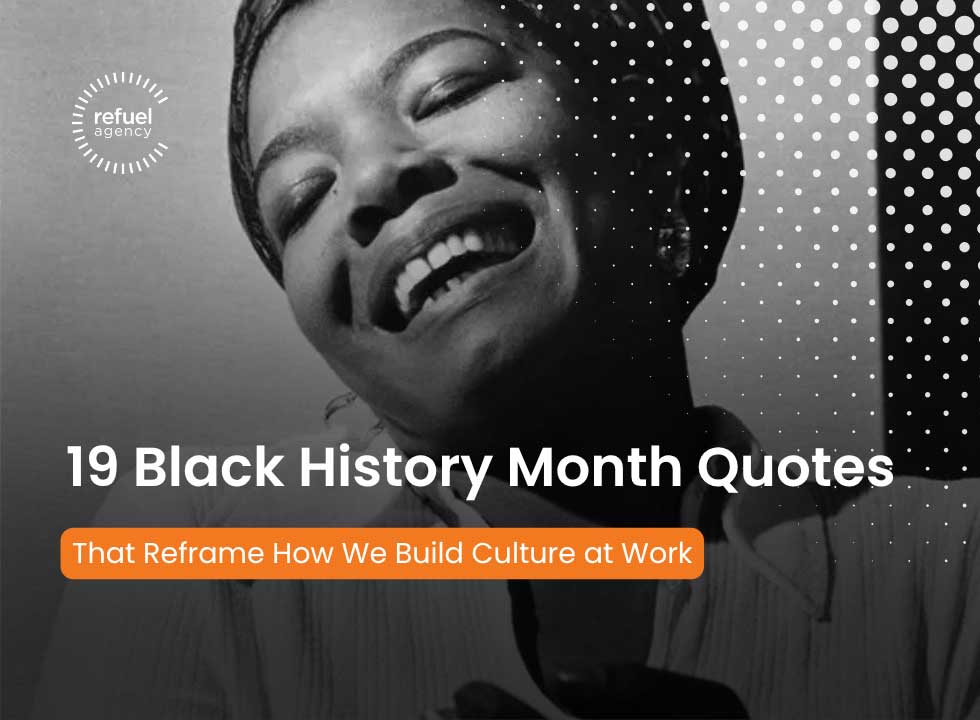
Black History Month quote collections tend to skew toward inspiration — words that feel good to read, share, and display. There’s real value in that. But the thinkers, activists, and leaders behind these quotes were doing something more specific: developing frameworks for navigating power, building sustainable change, and maintaining integrity under pressure.
These 19 black history month quotes are worth sitting with not because they’re motivating, but because they’re practically useful. They address real tensions that show up in professional life — how to advocate for yourself without burning out, how to lead without formal authority, how to define progress when traditional metrics don’t capture the full picture. The wisdom here was developed by people who had to think carefully and strategically about those exact challenges. That’s what makes it transferable.
TL;DR
- These quotes aren’t about motivation posters — they address real professional tensions: maintaining integrity under pressure, when to push back on flawed systems, and how to measure progress when traditional metrics fall short
- Each section connects to specific professional challenges: showing up authentically, handling setbacks, leading without conforming to outdated models, and defining success on your own terms
- The wisdom here was developed under significant pressure by people who had to think strategically about power and long-term change — which is exactly what makes it applicable well beyond its original context
Quotes That Challenge How We Show Up in Professional Spaces
Authenticity and professional expectations are in tension more often than most workplace culture conversations acknowledge. These inspiring quotes for Black History Month come from leaders who had to navigate that tension with precision — deciding when to adapt, when to hold ground, and what the real cost of each choice was. They offer a more nuanced framework than the binary of “be yourself” versus “play the game.”
When examining authentic community in workplace culture, consider how organizations can implement broader multicultural marketing strategies that honor diverse perspectives beyond surface-level representation.
| Professional Tension | Traditional Response | Alternative Framework |
| Code-switching pressure | Adapt completely to dominant culture | Selective authenticity based on context and real cost |
| Emotional labor expectations | Always be available and accommodating | Boundary-setting as strategic preservation |
| Conformity vs. authenticity | Choose one or the other | Integration that honors both professional goals and personal values |
| Visibility demands | Perform perfection constantly | Show up as a full person; prioritize impact over polish |
| Assimilation costs | Accept as price of advancement | Evaluate honestly whether the cost exceeds the benefit |
1. Maya Angelou on Presence Over Performance
“I’ve learned that people will forget what you said, people will forget what you did, but people will never forget how you made them feel.”
There’s a particular kind of pressure that comes with high-stakes moments at work — the fully rehearsed presentation, the carefully worded email, the meeting where you need to land a message clearly. Angelou’s observation reframes what actually registers. The energy you bring to a room, the way people feel heard or dismissed in a conversation — those things outlast the specifics of what was said.
This isn’t a case against preparation. It’s a case for presence as a professional skill. The goal isn’t flawless execution. It’s genuine engagement, and those aren’t always the same thing.
2. James Baldwin on Honest Communication
“Not everything that is faced can be changed, but nothing can be changed until it is faced.”
Corporate communication has a tendency toward softening — euphemisms, hedged language, feedback that obscures what actually needs to be said. Baldwin’s clarity cuts through that. In workplace terms, this is the difference between a difficult conversation that creates the possibility of change and a diplomatic one that leaves the underlying problem intact.
Speaking directly about what’s wrong — a failing strategy, a team dynamic that isn’t working, a project headed toward the wrong outcome — is professionally uncomfortable. Baldwin’s point is that discomfort is the cost of actually moving something. The alternative is maintaining the appearance of smooth operations while real problems compound.
3. Audre Lorde on Self-Preservation in Demanding Environments
“Caring for myself is not self-indulgence, it is self-preservation, and that is an act of political warfare.”
High-performance professional cultures often treat sustainability as optional — something to address once the urgent work is done. Lorde reframes the choice entirely. Self-preservation isn’t a concession to weakness; it’s a precondition for longevity. You can’t sustain creative, emotional, or strategic output from a depleted position.
This quote is particularly useful as a framework for boundary-setting in environments that reward overwork. The question isn’t whether you’re committed enough to push through. It’s whether you’re building a way of working that can last.
4. Toni Morrison on Defining Your Own Standards
“If you have some power, then your job is to empower somebody else.”
Morrison’s body of work was built on a refusal to write for external validation — she wrote for her own vision, and for readers who needed to see themselves reflected in literature. The professional application is about whose metrics you’re actually chasing. When you’re constantly seeking approval from existing hierarchies, your decisions get filtered through their priorities rather than your own judgment.
This is a harder shift to make than it sounds. Most feedback loops in professional environments reward alignment with existing standards. But the people who build things that last tend to have a clear internal compass that isn’t entirely dependent on external affirmation.
5. bell hooks on Building Authentic Community
“To build community requires vigilant awareness of the work we must continually do to undermine all the socialization that leads us to behave in ways that perpetuate domination.”
hooks wrote about community as intentional practice, not just proximity. In professional contexts, that distinction matters. A team is not automatically a community. People can work alongside each other for years without genuine trust, honest communication, or shared investment in each other’s success.
Real collaboration — the kind that sustains people through difficult projects and produces work that’s better than any individual could do alone — requires deliberate effort to create conditions where that’s possible. It doesn’t happen automatically from org charts or team off-sites.
Quotes That Shift How We Think About Progress and Setbacks
These powerful Black History Month quotes don’t offer the “fail fast and move on” framing common in many professional development spaces. They come from people who worked for change knowing it would take longer than their careers, and who built strategies accordingly. That perspective changes how you relate to slow progress, institutional resistance, and the gap between the work you’re doing now and the outcomes you’re working toward.
- Frederick Douglass on Sustained Effort
“Power concedes nothing without a demand. It never did and it never will.”
Douglass was describing the structure of how systems resist change — and that structure applies well beyond its historical context. In professional terms: resources, recognition, and opportunity rarely expand because someone quietly hoped they would. Advocating for a promotion, pushing back on unreasonable scope, asking for what a project actually needs — all of these require naming the ask directly and being willing to hold the position.
That’s not comfortable, especially in cultures that read directness as aggression. But Douglass’s observation reframes it: the discomfort of asking is simply part of how things move. Systems protect themselves. Change requires sustained pressure, not a single conversation.
- Fannie Lou Hamer on Incremental Change
“Nobody’s free until everybody’s free.”
Hamer built change through unglamorous, painstaking grassroots work — organizing one person, one conversation, one community at a time. There’s real pressure in many professional environments to make a visible, immediate impact. This quote is a useful counterweight to that pressure.
Some of the most durable work is incremental: building systems others will use after you’ve moved on, documenting institutional knowledge, having individual conversations that shift how someone thinks. These contributions don’t make great slides, but they compound. Hamer’s legacy is evidence that the work that lasts rarely looks impressive in the moment.
- Ella Baker on Collective Movement
“Strong people don’t need strong leaders.”
Baker was deliberate about distributing power rather than concentrating it. Her organizing philosophy was explicitly group-centered — building collective capacity rather than creating dependency on any individual, however skilled. The professional application is direct: organizations and teams that centralize knowledge, relationships, and decision-making in a single person are fragile. When that person leaves, the structure goes with them.
Building systems that outlast individuals, investing in others’ development even when it doesn’t directly serve your own advancement, sharing information generously — these aren’t instinctive behaviors in competitive environments. Baker’s framework makes a clear case for why they produce better long-term outcomes anyway.
- Bayard Rustin on Long-Term Vision
“The only weapon we have is our bodies, and we need to tuck them in places so wheels don’t turn.”
Rustin’s strategic clarity about movement building — understanding the system well enough to know exactly where to apply pressure — translates directly into how you think about roadmaps, business development, and career planning. Some decisions don’t yield returns for years. Building something durable often requires resisting the pressure to optimize for quarterly results at the expense of long-term positioning.
Rustin was also willing to work without credit and to support others’ leadership when that served the broader goal. That kind of strategic patience, combined with willingness to subordinate ego to outcome, is rare and valuable.
- Shirley Chisholm on Strategic Risk
“If they don’t give you a seat at the table, bring a folding chair.”
Chisholm ran for president knowing the institutional barriers were enormous — and did it anyway, because the act of running shifted what was considered possible. That reframes what “success” means when you’re taking a risk that might not pay off directly. Sometimes the point of a bold move is to open a conversation that wasn’t happening, to establish a precedent, or to make something easier for whoever comes next.
Not every risk will yield a direct return. Being intentional about why a risk is worth taking — beyond personal outcome — is what distinguishes strategic courage from impulsiveness.
Quotes That Reshape Leadership Beyond Traditional Frameworks
Conventional leadership models tend to center hierarchy, charisma, and formal authority. These quotes offer something more durable: leadership as intellectual rigor, consistent action, and systemic awareness. They’re especially useful when you’re leading without a title, trying to influence decisions you don’t control, or building in a context where traditional executive archetypes don’t apply.
When considering distributed leadership models, explore how influencer marketing strategies demonstrate how collective influence operates beyond traditional authority structures.
| Leadership Model | What It Prioritizes | What It Overlooks | Alternative Approach |
| Hierarchical authority | Title and position | Influence without formal power | Leadership as consistent action regardless of role |
| Charismatic individual | Personal magnetism | Sustainable systems | Group-centered capacity building |
| Command and control | Quick decisions | Collective intelligence | Distributed decision-making authority |
| Executive presence | Visibility and polish | Behind-the-scenes foundational work | Quiet influence through teaching and mentoring |
| Consistency as strength | Never changing position | Intellectual growth | Public evolution based on new information |
- Malcolm X on Intellectual Independence
“Education is the passport to the future, for tomorrow belongs to those who prepare for it today.”
Malcolm X’s intellectual evolution — his willingness to revise his positions publicly as he encountered new information — is as instructive as any specific idea he held. Most professional environments subtly reward consistency and treat changing your mind as instability or indecision. His example makes a different case: that rigorous, ongoing engagement with new information and willingness to update your thinking is a form of strength, not weakness.
That applies directly to strategy, to management approaches, and to how you engage with feedback. Intellectual independence means you’re accountable to evidence and reasoning, not to defending previous positions.
- Angela Davis on Systemic Awareness
“I am no longer accepting the things I cannot change. I am changing the things I cannot accept.”
Davis’s work consistently focused on understanding the systems producing the problems she was addressing — not just the surface-level symptoms. In organizational terms, this is the difference between reacting to individual situations and understanding the structural dynamics that keep producing them. When the same types of problems recur, it’s worth asking what system is generating them rather than addressing each instance separately.
That kind of systemic analysis requires patience and often reveals that the most effective intervention point isn’t where the problem is most visible.
- W.E.B. Du Bois on Education as Power
“The cost of liberty is less than the price of repression.”
Du Bois argued that education wasn’t just credential-building — it was the development of capacity for self-determination. In professional terms, that reframes how you think about skill development and where you direct your learning energy. Building genuine capability — understanding something deeply, developing judgment in a domain — creates options and autonomy that credentials alone don’t.
The decisions that compound most favorably over a career are often the ones that expand your capacity to think and act independently, even when the immediate return isn’t obvious.
- Ida B. Wells on Speaking Truth Regardless
“The way to right wrongs is to turn the light of truth upon them.”
Wells conducted investigative journalism under direct personal threat, publishing findings that powerful interests wanted suppressed. The professional application is less dramatic but shares the same structure: there are situations where accuracy and honesty require saying something that creates friction, and where the alternative — silence or softened truth — protects a problem rather than solving it.
This doesn’t mean every uncomfortable truth needs to be said in every context. But Wells’s work is a useful frame for evaluating the real stakes when you’re deciding whether to document what’s happening, name a problem clearly, or let a difficult thing pass unremarked.
- Septima Clark on Quiet Influence
“I have great belief in the fact that whenever there is chaos, it creates wonderful thinking. I consider chaos a gift.”
Clark ran literacy education programs that were foundational to the civil rights movement — largely outside public attention, in community spaces rather than on stages. The leadership model she demonstrated was built on teaching, mentoring, and doing preparatory work that others could build on.
Most leadership advice centers visibility. Clark’s example is a useful counterbalance: some of the most consequential influence happens in sustained, small interactions over time. If you’re doing foundational work — building infrastructure, developing others, creating systems — the absence of recognition doesn’t diminish the impact.
Quotes That Redefine What Success Actually Means
These quotes don’t offer alternative consolation prizes for missing traditional markers of success. They’re different frameworks entirely, built on self-knowledge, integrity, freedom, and meaningful action rather than status and external validation. They’re useful when you’re questioning whether the direction you’re moving actually aligns with what you want to build — or when you’ve achieved external markers of success and found them insufficient.
Redefining success metrics aligns with how young Black consumers are reshaping brand expectations around authenticity and values-driven engagement.
- Zora Neale Hurston on Self-Knowledge
“There are years that ask questions and years that answer.”
Hurston’s anthropological and literary work was rooted in deep engagement with culture and identity as subjects worthy of serious study on their own terms. Her frame for self-knowledge was observational and honest rather than aspirational. In professional terms: the clarity to understand your actual patterns, preferences, and limits — not what you think you should want — produces better decisions about projects, partnerships, and direction than optimizing for an external image of success.
Self-knowledge is slow, ongoing work. It tends to pay off in the quality of your judgment more than in any specific achievement.
- Langston Hughes on Deferred Dreams and Resilience
“Life is for the living. Death is for the dead. Let life be like music. And death a note unsaid.”
Hughes wrote unflinchingly about deferred dreams — what it costs to put something on hold, and what happens when postponement becomes permanent. That honesty is different from romanticizing struggle or reframing delay as secretly beneficial. Some things do get delayed by circumstances outside your control. Acknowledging the real cost of that, while also recognizing that deferred doesn’t mean destroyed, is a more useful frame than either denial or despair.
If you’re in a season of building capacity rather than executing on the actual goal, Hughes offers a way to hold both the frustration and the longer arc simultaneously.
- Nina Simone on Freedom as Practice
“You’ve got to learn to leave the table when love’s no longer being served.”
Simone’s definition of freedom centered the internal state — making decisions from choice rather than from fear or obligation. In professional terms, that kind of freedom is built incrementally: financial stability that creates genuine options, relationships that don’t require constant performance, a reputation that gives you some latitude to say no.
The goal isn’t a destination where you’ve finally “made it” and can relax. It’s a daily practice of building toward decisions that come from alignment rather than necessity. That requires different strategies than climbing a ladder — and a different way of evaluating progress.
- John Lewis on Good Trouble
“Do not get lost in a sea of despair. Be hopeful, be optimistic. Our struggle is not the struggle of a day, a week, a month, or a year, it is the struggle of a lifetime.”
Lewis’s concept of “good trouble” was specific: purposeful disruption that creates necessary friction to expose problems or force change — distinct from chaos. The professional application is knowing when the rules don’t serve the situation, and being willing to create the friction required to change them, with clear eyes about the consequences.
Good trouble is calculated. It means being willing to make things uncomfortable for the right reasons, and being honest about what that might cost. Lewis’s career was evidence that some of the most important contributions look like problems before they look like progress.
Bringing These Quotes Into Your Work
These 19 quotes represent frameworks developed by people who had to think carefully and strategically about power, sustainability, and long-term change — often in circumstances far more demanding than most professional contexts. The wisdom transfers precisely because it was developed under pressure, tested against real resistance, and refined over time.
The point isn’t to appropriate their struggles or use these quotes as simple motivation. It’s to learn from frameworks that are genuinely sophisticated about how change works, how integrity holds up under pressure, and what it actually means to build something lasting.
Organizations looking to translate these values into actionable strategies should explore Black History Month marketing campaigns that move beyond performative gestures toward authentic engagement.
If you’re working through how to apply these ideas to culture-building, brand positioning, or team dynamics, Refuel has helped organizations translate values into strategy for over 37 years. Learn more about our approach.
Final Thoughts
The most useful thing about these black history month quotes isn’t that they’re inspiring — it’s that they’re specific. They address real professional tensions with more precision than generic motivation does: what authentic presence actually requires, how change moves through resistant systems, what leadership looks like when it isn’t about title or visibility, and what you’re actually optimizing for when you define success.
For more perspectives on how historical wisdom informs contemporary strategy, explore our collection of inspiring quotes from African American leaders across multiple contexts.
We didn’t set out to avoid familiar quotes entirely — some of the most-cited lines earned their prominence. But we focused on ideas that have direct professional application and challenge conventional thinking about work, impact, and what it means to build something worth building.
Use these as diagnostic tools. When you’re stuck on a decision, facing a setback, or questioning your direction, the frameworks here won’t give you easy answers. They’ll help you ask better questions about what you’re actually working toward and whether your current approach reflects that.
